There's a study most women haven't heard about. In 2022, Dr. James Pfaus and his team at Charles University in Prague published research analyzing pelvic floor contractions during orgasm in people with vulvas. They found something interesting. There isn't one universal orgasm. There are at least three distinct patterns, and each one tells you something about how your pelvic floor functions.
That matters more than it sounds. The same pelvic floor that shapes your orgasm also helps keep your urethra closed, supports complete bladder emptying, and plays a role in whether bacteria introduced during sex stick around long enough to cause infection.
Roughly 85% of UTIs in women are caused by E. coli. The majority of those infections trace back to sex, where bacteria are mechanically introduced from the vaginal area into the urethra. Pelvic floor function affects how efficiently the body clears that bacteria. So does daily prevention.
This is a piece about orgasm, anatomy, and the science of why post-sex UTIs happen. Stay with me. The connections are real.
The Pfaus Study and the Three Orgasm Patterns
The 2022 research used a sensor-equipped vibrator (the Lioness) to track pelvic floor contractions during masturbation in 54 participants over multiple days. The team analyzed the rhythm and force of those contractions and found three distinct patterns.
The Wave. The most common pattern, observed in nearly half of participants. Successive contractions of tension and release that build steadily, like undulations. This is what most people picture when they imagine an orgasm.
The Avalanche. About 30% of participants. Higher baseline pelvic floor tension throughout the buildup, with a release that's just as climactic as a volcano but follows a different physiological arc.
The Volcano. The least common pattern, around 20% of participants. Lower pelvic floor tension during buildup, then a sudden, explosive contraction and release at climax.
None of these patterns is better than the others. None means anything is wrong. But they reveal that pelvic floor function during orgasm varies meaningfully between individuals, and that variation reflects how your pelvic floor muscles coordinate, contract, and release more broadly.
That's relevant beyond pleasure. The same coordination affects continence, complete bladder emptying, and post-sex bacterial clearance.
Erogenous Zones and the Many Routes to Orgasm
Before we get to the urinary tract piece, it's worth naming that orgasms come from many places. The Pfaus study looked at pelvic floor contractions, but pelvic floor activity is just one signal of an experience that happens throughout the body and brain.
Common pathways to orgasm include external clitoral stimulation (which most research suggests is the most reliable route for around 80% of people with vulvas), internal clitoral stimulation (the clitoris is much larger than the visible glans, with structures extending under the surface around the vaginal opening), G-spot stimulation along the upper vaginal wall, cervical stimulation deeper inside the vagina, blended orgasms that combine multiple zones simultaneously, and orgasms triggered through nipples, anal stimulation, exercise (sometimes called core-gasms), breath and visualization, and sleep.
What unites them is the involvement of the pelvic floor in the muscular response. Even orgasms that originate in non-genital erogenous zones recruit the pelvic floor during climax. This is part of what makes orgasm a full-body event rather than a localized one.
It's also part of why pelvic floor health matters across so many areas of women's wellness, including urinary tract function.
How Pelvic Floor Function Affects UTI Risk
Here's the connection that doesn't get made in most orgasm content or most UTI content: the pelvic floor sits at the intersection of both.
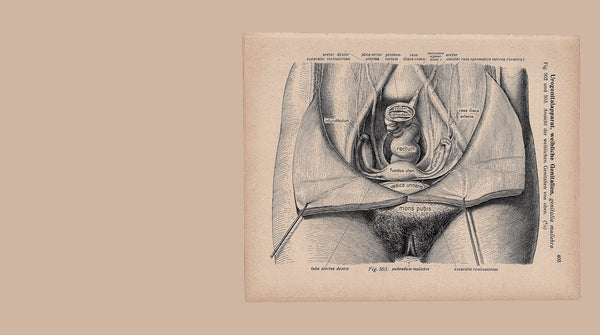
The pelvic floor is the network of muscles that supports the bladder, uterus, and bowel. It does several things relevant to urinary tract health:
It helps keep the urethra closed when you're not actively urinating, which is why a weak pelvic floor causes stress incontinence (peeing during exercise, sneezing, or laughing).
It coordinates with the bladder to fully empty urine when you do pee. Incomplete bladder emptying leaves residual urine sitting in the bladder, which gives bacteria more time to multiply.
It plays a role in the post-sex bacterial flush. When you urinate within 30 minutes of sex, the volume and force of that urination matter. A coordinated pelvic floor produces a stronger, more complete stream that effectively clears bacteria from the urethra. A dysfunctional pelvic floor produces a weaker stream that's less protective.
This means that women with pelvic floor weakness or dysfunction (which is extremely common postpartum, in perimenopause and menopause, and after long-term stress incontinence) are at higher UTI risk in part because their bodies are less efficient at clearing bacteria after sex.
The 85% Number and What It Actually Means
Roughly 85% of UTIs in women are caused by uropathogenic E. coli, the strain of E. coli that has evolved specifically to colonize the urinary tract. The remaining 15% are caused by other bacteria like Klebsiella, Proteus, and Staphylococcus saprophyticus.
The majority of those E. coli infections trace back to sexual activity. Bacteria that live around the vagina and perineum are mechanically introduced into the urethra during friction, where they can climb upward into the bladder, attach to the bladder wall, and multiply. This is why post-sex UTIs are so common, why they're called "honeymoon cystitis" when they happen after periods of high intimacy frequency, and why pelvic floor function and post-sex urination are so important.
It's also why E. coli adhesion is the specific mechanism that prevention has to address. Once E. coli attaches to the bladder wall, the body's natural clearance can't easily flush it out. The bacteria multiply, biofilm forms, and infection follows. If you can prevent the initial adhesion, you prevent the infection.
That's exactly what UTI Biome Shield is designed to do.
How UTI Biome Shield Targets E. coli Adhesion
UTI Biome Shield was built around a specific clinical mechanism: blocking E. coli from adhering to the urinary tract. Each capsule delivers 38mg of A-type proanthocyanidins (PACs) from cranberry, the only compound clinically proven to interfere with E. coli's ability to attach to bladder wall cells. PACs work by binding to E. coli's fimbriae (the hair-like projections it uses to grip onto tissue) and rendering them ineffective.
Most cranberry supplements contain less than 5mg of active PACs, which is far below the dose needed to meaningfully block adhesion. UTI Biome Shield uses DMAC-verified A-type PACs at the clinically studied dose, in a double-extracted, soluble formulation designed for bioavailability.
The formula also includes 500mg of D-mannose (which binds to a separate E. coli receptor and helps flush attached bacteria), vitamin D3 and zinc (which support the urothelial barrier and immune response), and whole-fruit polyphenols (which help disrupt biofilm and reduce inflammation).
Three systems working together: adhesion blocking, mechanical flushing, and tissue and immune support.
Daily Plus Pre-Coital: Why the Dosing Strategy Matters
The protocol is intentional. UTI Biome Shield is taken daily to maintain protective PAC levels in the urinary tract around the clock, plus one additional capsule 30 to 60 minutes before sex.
Daily dosing keeps adhesion blocking active during background bacterial introduction (which happens through normal anatomy, not just sex) and supports the cumulative tissue and microbiome benefits that build over time.
The pre-coital capsule addresses the specific window of highest bacterial introduction risk. PACs reach peak concentration in the urinary tract within 1 to 2 hours of dosing and remain active for up to 12 hours. Taking a capsule before sex means E. coli that's introduced during intimacy encounters PAC-saturated tissue and can't get a foothold.
This dual-strategy dosing is built into UTI Biome Shield specifically because that's how the bacterial reality works. Most UTI products on the market are designed to react after symptoms appear. UTI Biome Shield was designed to prevent the adhesion event before it triggers infection.
Pelvic Floor PT and the Other Half of the Equation
If pelvic floor function affects post-sex bacterial clearance, then strengthening and coordinating the pelvic floor is part of comprehensive UTI prevention.
For women dealing with stress incontinence, recurrent UTIs, postpartum recovery, or pelvic discomfort, a pelvic floor physical therapist can assess muscle coordination, bladder emptying, and pelvic stability, and prescribe targeted exercises to support recovery. Pelvic floor PT is standard postpartum care in many countries and significantly underused in the US.
Combined with a daily prevention protocol, pelvic floor strengthening addresses both the bacterial side (adhesion blocking through UTI Biome Shield) and the structural side (efficient bladder emptying and post-sex flushing) of UTI risk.
What Your Orgasm Pattern Doesn't Mean
A few caveats worth stating clearly.
The Pfaus study's three patterns are descriptive, not diagnostic. Having a wave, avalanche, or volcano orgasm doesn't tell you anything definitive about your urinary tract health. Plenty of women with strong pelvic floors get UTIs, and plenty with weaker pelvic floors don't. The connection between pelvic floor function and UTI risk is statistical, not deterministic.
Orgasm typology shouldn't be used as a self-diagnosis tool. If you have stress incontinence, recurrent UTIs, or other symptoms suggesting pelvic floor dysfunction, the answer is to see a pelvic floor PT, not to analyze your orgasm pattern.
And finally: there's no "right" way to orgasm. The Pfaus research is interesting because it expands our understanding of physiological variation, not because it ranks one pattern above another. Whatever orgasm your body has access to is the right one.
The reason this matters at all is that the same anatomy that produces orgasm also affects bladder health, post-sex bacterial clearance, and UTI risk. Understanding your body as an integrated system, instead of a collection of separate parts, is part of how women's wellness shifts from reactive treatment to actual prevention.
Frequently Asked Questions
Why is pelvic floor health connected to UTIs?
The pelvic floor muscles help control urination by keeping the urethra closed when you're not actively peeing and by coordinating with the bladder to fully empty urine when you are. When pelvic floor function is weak or uncoordinated, residual urine stays in the bladder longer, giving bacteria more time to multiply. This raises UTI risk, especially after sex when bacterial introduction is at its highest.
What percentage of UTIs are caused by E. coli?
About 85% of UTIs in women are caused by uropathogenic E. coli, a strain that has evolved to colonize the urinary tract by adhering to bladder wall cells. The majority of these infections happen after sexual activity, when E. coli from the vaginal area is mechanically introduced into the urethra. This is why E. coli adhesion blocking is the specific mechanism most relevant to UTI prevention.
How does cranberry actually prevent UTIs?
The active compounds in cranberry that prevent UTIs are A-type proanthocyanidins (PACs), which bind to E. coli's fimbriae (the hair-like projections it uses to attach to tissue) and prevent the bacteria from gripping onto bladder wall cells. The clinical dose shown to meaningfully block adhesion is 36 mg of A-type PACs. Most over-the-counter cranberry supplements contain less than 5 mg, which is far below the threshold needed for protection.
What does pre-coital UTI prevention actually do?
Pre-coital prevention addresses the highest-risk window for bacterial introduction. Taking a UTI prevention capsule 30 to 60 minutes before sex means peak PAC concentration is in the urinary tract during the window when E. coli is most likely to be introduced. The bacteria encounter PAC-saturated tissue and can't attach. This is different from reactive treatment after symptoms appear.
Should you do Kegels to prevent UTIs?
Kegels can support pelvic floor strength but aren't a complete answer. Many women do Kegels incorrectly or compensate with other muscles, which can actually worsen pelvic floor dysfunction. A pelvic floor physical therapist can assess your specific function and prescribe targeted exercises, which is more effective than generic Kegel routines. Pelvic floor PT is significantly underused in the US compared to many other countries.
Are orgasms good for pelvic health?
Yes. The pelvic floor contractions during orgasm are a form of muscle exercise that supports tone and coordination. Regular orgasm has been associated with improved pelvic floor strength, increased blood flow to pelvic tissue, and better lymphatic drainage. None of this prevents UTIs by itself, but it contributes to the overall pelvic health that makes the body more resilient.
Does the type of orgasm I have mean anything about my health?
Not really. The Pfaus study's three patterns (wave, avalanche, volcano) are descriptive variations in pelvic floor contraction during orgasm, not diagnostic markers. Plenty of women with strong pelvic floors get UTIs, and plenty with weaker ones don't. If you have specific symptoms like stress incontinence or recurrent UTIs, the answer is to see a pelvic floor PT, not to analyze your orgasm pattern.