(And How They Protect You From UTIs)
Let's talk about something nobody prepared you for: your pelvic floor. Those muscles you can't see but are supposed to somehow magically keep your bladder, uterus, and rectum from falling out of your vagina, while also preventing pee leaks, supporting orgasms, and protecting you from a half-dozen common conditions nobody warned you about. No big deal, right?
We're expected to just know about pelvic floor health. Nobody teaches us. Not in sex ed. Not at the gynecologist's office. Not even after we push a human out of our bodies. We're just supposed to figure it out on our own, and then feel ashamed when things don't work the way they should.
Your pelvic floor deserves attention, understanding, and care. Not shame, not silence, not dismissal.
This is the foundational guide. If you want to go deeper on a specific application (orgasm, postpartum recovery, UTI prevention, painful sex), the related articles are linked throughout.
What Is Your Pelvic Floor?
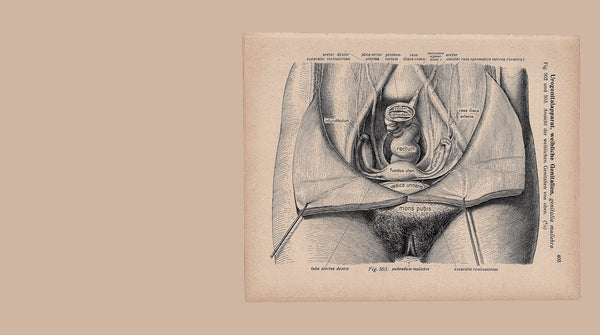
Your pelvic floor is a hammock of muscles, ligaments, and connective tissue at the base of your pelvis. It runs from the pubic bone in front to the tailbone in back, and side to side between the sit bones. The whole structure supports your bladder, uterus, and rectum, and includes the openings for the urethra, vagina, and anus.

When functional, your pelvic floor does five things:
- Supports your pelvic organs against gravity.
- Controls urination and bowel movements by keeping the relevant openings closed when you're not actively using them.
- Coordinates with your bladder and bowel to fully empty when you do.
- Plays a central role in sexual function and orgasm.
- Works with your core muscles to stabilize your spine and pelvis.
Think of your pelvic floor as a trampoline. When it's strong and responsive, it bounces back. When it's weak or overly tight, things stop working the way they should, and the failure modes look different depending on which function breaks first.
What Pelvic Floor Dysfunction Actually Looks Like
Pelvic floor dysfunction is one of the most common, most under-recognized conditions affecting women. Estimates suggest at least one in three women experience some form of it during their lifetime, and that number is almost certainly low because most women don't bring symptoms up at appointments.
The signs are varied and easy to dismiss as "normal" things that women just deal with.
Urinary symptoms. Leaking urine when you cough, sneeze, laugh, jump, or lift (stress incontinence). Sudden, urgent need to pee that you can barely make it to the bathroom for (urge incontinence). Frequent UTIs from incomplete bladder emptying. Difficulty starting urination or feeling like you can't fully empty.
Sexual symptoms. Painful sex (dyspareunia). Difficulty reaching orgasm or weaker orgasms over time. Vaginismus or pelvic muscle spasms during penetration. Loss of sensation.
Structural symptoms. A sensation of heaviness or pressure in your pelvis, especially at the end of the day. A visible or palpable bulge at the vaginal opening (pelvic organ prolapse). Lower back pain that doesn't respond to typical treatment. Pelvic pain or discomfort during exercise.
Bowel symptoms. Constipation or straining. Difficulty fully emptying. Fecal incontinence. Pain or pressure during bowel movements.
If any of this resonates, the answer isn't to live with it. The answer is pelvic floor physical therapy.
Pelvic Floor Through Life Stages
Your pelvic floor responds to every major hormonal and physical event in a woman's life. The same muscles do different work at different stages, and they need different support depending on what your body is dealing with.
Pregnancy. Your pelvic floor takes on extraordinary work during pregnancy: supporting a growing baby, adapting to hormonal changes that loosen tissues, preparing for labor and delivery. Common issues include urinary leakage, pelvic pressure, increased UTI risk, and pelvic girdle pain. What helps: see a pelvic floor therapist during pregnancy (yes, it's safe and recommended), do gentle pelvic floor work but also focus on relaxation, practice perineal massage in the third trimester, work on optimal birthing positions.
Postpartum. Whether you had a vaginal birth or C-section, your pelvic floor needs attention. Vaginal birth involves significant stretching and possible tearing of pelvic floor muscles. C-section, while bypassing vaginal birth, still involves pregnancy effects on the pelvic floor plus surgical trauma. Common postpartum issues: urinary incontinence, pelvic organ prolapse, painful sex, recurrent UTIs, diastasis recti. Every postpartum woman should see a pelvic floor therapist, not just those with obvious problems. France and many other countries automatically prescribe pelvic floor therapy postpartum. The U.S. should too.
For the deeper postpartum story, including how pelvic floor dysfunction drives recurrent UTIs after birth, see Postpartum UTIs and the Pelvic Floor Story Nobody Told Me.
Perimenopause and menopause. Estrogen loss affects your pelvic floor by causing tissue thinning (less elasticity, more fragility), muscle weakening (loss of strength and tone), reduced blood flow to pelvic tissues, and increased vulnerability to a range of conditions grouped under genitourinary syndrome of menopause (GSM). What helps: vaginal estrogen (often a game-changer for tissue health), continued pelvic floor work, addressing any prolapse with your provider, treating dryness and atrophy directly.
For more on the menopause connection specifically, see UTIs in Menopause: The Dual Strategy and Vaginal Estrogen for UTI Prevention.
After 40, generally. Even without pregnancy or menopause as direct triggers, time itself affects pelvic floor function. Years of holding it, chronic constipation, high-impact exercise without core conditioning, repeated heavy lifting, and chronic coughing or sneezing from allergies all add up. Pelvic floor symptoms in your 40s and 50s aren't always menopause. Sometimes they're decades of accumulated wear that has finally surfaced.
Pelvic Floor and Sexual Function
The pelvic floor plays a central role in sexual response. Strong, coordinated pelvic floor muscles support arousal, sensation, and orgasm. The contractions you feel during orgasm are pelvic floor contractions. Reduced strength, coordination, or relaxation capacity all affect sexual experience.
For more on the orgasm-pelvic floor connection, including the 2022 Pfaus study showing three distinct orgasm patterns based on pelvic floor activation, see Your Pelvic Floor, Your Orgasm, Your UTI Risk.
Pelvic Floor and UTIs
This is one of the most under-explained connections in women's health. Pelvic floor muscles help fully empty the bladder during urination by coordinating with the bladder muscles to push urine out completely. When the pelvic floor is weak, tight, or uncoordinated, residual urine sits in the bladder. The longer urine sits, the more time bacteria have to multiply, and the higher the UTI risk becomes.
This is why pelvic floor dysfunction is one of the silent drivers of recurrent UTIs, especially postpartum and after menopause. Standard prevention advice (peeing after sex, hydration, cranberry) doesn't address this mechanism at all.
For the full story, see Your Pelvic Floor, Your Orgasm, Your UTI Risk and Postpartum UTIs and the Pelvic Floor Story Nobody Told Me.
How to Strengthen and Support Your Pelvic Floor
Beyond Just "Kegels"
When people think of pelvic health, they immediately think of Kegels. But what is a Kegel? Simply put, it is just a contraction and relaxation of your pelvic floor muscles, no different than a bicep curl.
The misconception is that Kegels are a cure-all for every pelvic symptom. In reality, your pelvic floor shouldn't be constantly "tight." It needs to sit at a healthy, adaptable neutral at rest. This allows it to automatically contract when you need it most, like when your core engages, or when you cough, laugh, or sneeze, and fully release when you don't.
Understanding the muscle cycle. For any muscle to work efficiently, it must go through a full range of motion. If you have been told to do Kegels obsessively, you might actually be creating a hypertonic (overly tight) pelvic floor. Squeezing a muscle that is already tight won't make it stronger; it will just make it fatigued and dysfunctional.
Before committing to a repetitive squeezing routine, here is how to find your baseline coordination:
- The inward and upward lift. To identify a contraction, imagine gently drawing the muscles around your vaginal opening inward and upward, as if lifting a pebble.
- The equal release. Just as important as the lift is the drop. You should feel the muscles completely let go and return to a neutral, resting state.
The case for a professional assessment. Because the pelvic floor is hidden from view, it can be tough to know if your baseline is too tight, too weak, or simply uncoordinated. This is exactly why checking in with a pelvic floor physical therapist is invaluable. They can assess your unique resting tone and tell you whether your body needs strengthening, down-training (relaxation), or a dynamic mix of both.
Diaphragmatic Breathing
Place one hand on your chest, one on your belly. Inhale deeply through your nose, allowing your belly to expand. Feel your pelvic floor gently lengthen and relax on the inhale. Exhale slowly through your mouth. Feel your pelvic floor gently lift and engage on the exhale.
Practice 5 to 10 minutes daily. This connects your breath to your pelvic floor and is the foundation of most clinical pelvic floor therapy.
Daily Movement
Walking activates your core, improves circulation to pelvic tissues, and supports pelvic floor function naturally. Aim for 30 minutes most days.
Mind your posture. Slumping or chronically crossing your legs can strain pelvic muscles over time.
Deep squats lengthen and relax the pelvic floor, which is great for pregnancy preparation, constipation relief, and overall pelvic health. Stand with feet slightly wider than hip-width, lower into a deep squat with heels on the ground if possible, hold for 30 to 60 seconds while breathing deeply.
What to Avoid
- Peeing too frequently ("just in case" peeing). This gets you into a vicious cycle of peeing before you're full, which is a low quality of life. Normal peeing is every 2 to 4 hours, for at least 12 seconds each time.
- Holding your pee for hours. Trains your pelvic floor and bladder out of healthy coordination.
- Chronic constipation and straining. Damages pelvic floor muscles over time.
- High-impact exercise without core conditioning if you're already symptomatic. Running, jumping, and heavy lifting can worsen prolapse or incontinence if the foundation isn't there.
- Doing Kegels constantly without ever learning to relax. As mentioned, this is the most common mistake in pelvic floor work.
When to See a Pelvic Floor Therapist
You should see one if you experience any of the following:
- Leaking urine with coughing, sneezing, laughing, jumping, or lifting.
- Urgent, frequent need to urinate.
- Recurrent UTIs.
- Painful sex.
- Difficulty reaching orgasm or weaker orgasms over time.
- Constipation or straining.
- Sensation of heaviness or pressure in your pelvis.
- A visible or palpable bulge at the vaginal opening.
- Lower back pain that doesn't respond to typical treatment.
Even without symptoms, see a pelvic floor therapist during pregnancy (to prepare for birth), postpartum (every woman should have at least one visit), and perimenopause (proactive strengthening pays compound interest). In most states you can book directly, with no physician referral required.
What Happens During Pelvic Floor Therapy
First visit, 45 to 60 minutes. The therapist will start with a conversation about symptoms, medical history, pregnancies, births, surgeries, bathroom habits, and sexual health. This is more comprehensive than most gynecologic appointments.
Dr. Tanya Goodrich on what to expect at a first pelvic floor PT visit.
External exam comes next, assessing posture, abdominal muscles, hips, and lower back. The pelvic floor doesn't work in isolation, and a good therapist examines the whole structure.
Internal exam, if you consent, where the therapist inserts a gloved finger into the vagina (or rectum if needed) to assess muscle function, strength, tension, coordination, and any tender or trigger points. This is clinical, not invasive in the way a pap smear or speculum exam can feel. You can stop at any time.
Treatment plan with personalized exercises, breath work, manual techniques, and self-care to practice at home.
You can always ask questions, voice concerns, bring a support person, and stop at any time. A good therapist will never pressure you and will always work at your pace.
Finding a Pelvic Floor Therapist
Pelvic floor PT is increasingly recognized as an essential component of comprehensive healthcare, but finding the right provider can feel overwhelming depending on your location. Whether you're looking for local, specialized in-person care or broad educational resources, here are the best places to start.
Specialized care and expert practices
· Healthy Pelvis Physical Therapy. Founded by Dr. Tanya Goodrich, PT, DPT, Healthy Pelvis is a specialized practice dedicated to treating complex pelvic floor dysfunction, offering both in-person and telehealth appointments. For patients looking for individualized, evidence-based care that addresses the root cause of pelvic health issues, seeking out specialized clinics like Healthy Pelvis is the gold standard.
· Pelvicrehab.com. A comprehensive, searchable directory dedicated to certified pelvic floor specialists, making it easier to locate a practitioner in your area.
· The American Physical Therapy Association (APTA) directory. The APTA's national database lets you filter licensed physical therapists by pelvic health and pelvic floor rehabilitation.
Digital resources and virtual education
· Sara Reardon (@thevaginawhisperer). One of the most accessible pelvic floor educators online, offering digital programs and remote insights for those without local access to a specialist.
Navigating referrals
· Leverage your medical team. In most states you can see a pelvic floor PT directly, with no referral required. If you'd still like a recommendation, ask your OB/GYN, midwife, or primary care provider.
· The urogynecology route. If your provider doesn't have a specific therapist to recommend, ask for the name of a local urogynecology practice. Because urogynecologists work hand in hand with pelvic floor rehabilitation, calling their office directly is one of the fastest ways to get a list of trusted local PTs.
Take Care of Your Pelvic Floor
Your pelvic floor is foundational to bladder and bowel control, sexual function, pregnancy and birth, recovery from major life events, and aging well. Pelvic floor problems are incredibly common, but they aren't an inevitability you have to live with.
Whether you're 25 or 75, it's never too late to start caring for your pelvic floor.
You only get one. Take care of it.
Frequently Asked Questions
What is the pelvic floor? The pelvic floor is a hammock of muscles, ligaments, and connective tissue at the base of your pelvis. It supports your bladder, uterus, and rectum, controls urination and bowel movements, plays a central role in sexual function, and works with your core to stabilize your spine. When it's functional, you don't notice it. When it's dysfunctional, the symptoms range from incontinence to painful sex to recurrent UTIs.
What does pelvic floor dysfunction feel like? It varies by which function is affected. Common signs include leaking urine when you cough, sneeze, laugh, or jump; sudden urgent need to pee; painful sex or weaker orgasms; difficulty fully emptying your bladder or bowels; a sensation of heaviness or pressure in your pelvis; and lower back pain that doesn't respond to typical treatment. Many women dismiss these as "normal" things women deal with, but they're symptoms of an addressable condition.
Should I see a pelvic floor PT even if I don't have symptoms? Yes, if you've been pregnant, given birth, gone through menopause, or had pelvic surgery. France refers every postpartum woman to pelvic floor PT automatically, and several other European countries do too. The American system doesn't, but the underlying logic is the same: every woman who has gone through a major pelvic event benefits from at least one assessment, even if no obvious problems have surfaced. Prevention is dramatically easier than treatment.
Are Kegels enough? Sometimes, but not always. Many women have over-tight pelvic floors rather than weak ones, and obsessive Kegels can make symptoms worse. Other women do Kegels incorrectly and don't strengthen the right muscles. A pelvic floor PT can assess what your specific pelvic floor needs (strengthening, relaxation, coordination work, or some combination) and prescribe targeted exercises that actually help.
Can pelvic floor problems be fixed without surgery? Most can. Pelvic floor PT, lifestyle changes, and targeted exercises resolve or significantly improve the majority of pelvic floor dysfunction. Surgery is reserved for severe cases (significant prolapse, complete failure of conservative treatment) and is increasingly seen as a last resort rather than a first option. If a provider jumps straight to surgery without offering pelvic floor PT first, get a second opinion.
How does pelvic floor health affect UTIs? Pelvic floor muscles coordinate with your bladder to fully empty during urination. When the pelvic floor is weak, tight, or uncoordinated, residual urine sits in the bladder, which gives bacteria more time to multiply. This is one of the silent drivers of recurrent UTIs, especially postpartum and after menopause. Standard prevention advice (peeing after sex, hydration, cranberry) doesn't address this mechanism, which is why women with pelvic floor dysfunction often cycle through "recurrent UTIs" without ever finding lasting prevention.
How does pelvic floor health affect sex? The pelvic floor muscles are central to arousal, sensation, and orgasm. The rhythmic contractions you feel during orgasm are pelvic floor contractions. Strong, coordinated pelvic floor muscles support more intense and reliable orgasm. Weakness, tightness, or trauma can result in painful sex, weaker orgasms, vaginismus, or difficulty reaching orgasm. Pelvic floor PT can address all of these.